


The following is an editorial written by Brandon Hodges, Former SD-31 SREC Committeeman, 2024–2026 and MISD Trustee.
On April 23 of this year, I sent a two-page letter to Republican Party of Texas Chairmans Abraham George. I sent it as an elected State Republican Executive Committee member for Senate District 31. In it I withdrew my support for his re-election and endorsed D’rinda Randall.
That was the part people talked about. It was the least important part.
The rest of the letter described a party losing its working parts. Fewer delegates were coming out across the state, and the numbers showed the same decline. Young people, including my own son, a top-of-class engineering graduate, looked at the party and saw in-fighting, little attention to the economic questions that decide their standard of living, and no serious effort to apprentice them into leadership. Conservative school board members and local officials had been left on their own. Party staff were working the phones against elected volunteers.
I asked for three things before the June convention. A directive that staff stop pressuring or retaliating against members. A public statement that dissent is welcome in a grassroots party. An open review of internal governance. None of it was radical. I received little engagement in reply.
At the June convention, Randall defeated George for the chairmanship. Her materials and contemporaneous reporting described an overwhelming unity vote — on the order of four to one. I had endorsed that change because the status quo under George was failing the people who do the work. A new chair was supposed to mean a new focus: capacity over faction, November over March, volunteers treated as owners rather than subjects. Endorsing a change is not a blank check. Results still count.
What followed did not fix the problem I wrote about in April. It renamed it.
In August, GOP Chair Randall named Rhonda Ward Political Director of the Republican Party of Texas. The job oversees statewide political operations, candidate support, grassroots mobilization, and election strategy — the machinery that is supposed to prepare a party for November. Ward had lost the March Republican primary for Texas Senate District 3. Placing a failed primary candidate into a leadership position at the state party should be agnostic, not antagonistic. The Chair of the GOP should have easily identified the conflicts arising and known this is not helpful in rebuilding a statewide political operation. Chair Randall put a recently defeated primary candidate over the party’s political apparatus heading into a general election year. That call was hers.
On November 3, Texas Republicans lost every statewide race on the ballot. Governor. Lieutenant Governor. Attorney General. Comptroller. Agriculture Commissioner. Land Commissioner. A seat on the Railroad Commission. From the Governor’s Office to the General Land Office, from agriculture to oil and gas oversight, the party lost the offices that run Texas agencies day to day. Early reporting from the Texas Tribune and The Texan also projects a net Republican loss of roughly 21 seats in the Texas House — Democratic control for the first time in more than two decades. Final counts will settle the House number. The upper ballot is already settled. Influence over the executive branch and the agencies that touch land, energy, farming, law, and money is gone. The House is where the next decade of maps and budgets will be decided. Together, that is the bill.
I saw a bloodbath coming. I did not know how deep it would run — the exact seat count, the top of the ticket, the full map of the night. No one did. But the pattern was already visible half a year earlier: thinning participation, internal fights eating the turnout habit, a party more practiced at policing its own than at winning Novembers. That is why I wrote in April. The warning was on paper while there was still time to change course. The bill came due on November 3. Changing the name on the letterhead did not change the habits.
The clearest earlier example is the one I put in writing in April, under the George era.
The party’s general counsel is an appointed adviser, not an elected officer. The rules limit that job to legal advice. The seat is honorary and non-voting. Staff are supposed to stay neutral in fights inside the party. Yet Rachel Hooper, the Texas GOP’s attorney, publicly lambasted a sitting Republican legislator, Brian Harrison — telling him to “sit down and shut up,” that he was “not a Republican,” and that he was a “disgrace to Texas.” Whatever one thinks of Representative Harrison, that is not neutrality. It is staff deciding who belongs.
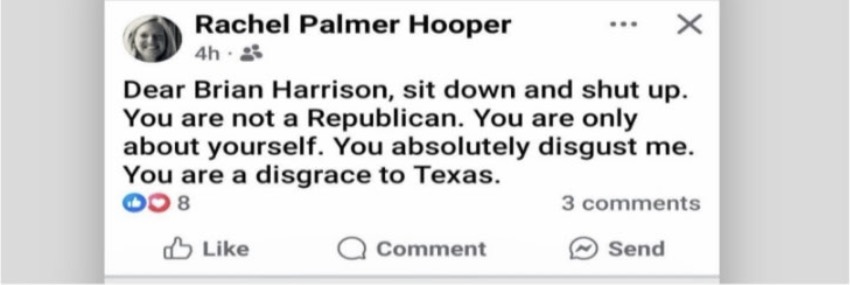
Notice two things. First, leadership. Chairman George allowed it. Hooper did it. And as vice-chair at the time, D’rinda Randall showed zero public leadership in calling foul on either of them. That was a leadership failure. It is easy to pressure people to resign once you have power. Bold leadership is calling balls and strikes when you lack power. That is what we call integrity. Second, what followed. Harrison won his hard-fought re-election. Over a dozen of his peers in the Texas House did not. That speaks volumes about what the Texas GOP was focused on — policing its own ranks instead of building the capacity to win. When volunteers are treated as subjects rather than customers, they rarely argue. They simply stop coming. That is what a declining delegate count looks like from the inside. In a close year, it is also what turnout looks like. The names changed after June. The focus did not. Under George, internal enforcement while participation thinned. Under Randall, with Ward over political operations, the same wrong focus — only this time the statewide ticket and the House were the invoice. A list of excuses and blame game after a slaughter is not a substitute for the capacity work that should have been the focus from the start.
Chairman Randall spent much of the cycle on the national rally circuit. Texas has 254 counties. You cannot lead from the big stages while the counties that carry the base, and the campuses that form the next generation, go without consistent presence. Rural turnout that falls short of what the party needs is not a mystery when the year-round work in those counties was never the priority. The same is true of universities. Campuses in Austin, Lubbock, San Marcos, and Dallas have been conceded for years as liberal breeding grounds. The party then wonders why those students overwhelmingly vote socialist. Growing the party means showing up on those campuses with a clear message and consistent presence, not ignoring them until Election Day.
Losing the statewide offices is not a scoreboard. It is a lever — now in the other party’s hands. Democrats control the Governor’s Office, the Lieutenant Governor’s gavel over the Senate calendar, the Attorney General’s lawsuits, the Comptroller’s books, the Agriculture Department, the General Land Office, and a voice on the Railroad Commission. They also hold the Texas House, with real influence over the state budget, election administration, and the legislative process that will shape the maps drawn after the 2030 census. They will help shape the next round of federal judicial nominations from Texas. Maps can lock in advantages for a decade. Budgets compound. Agency power compounds faster. A lost majority and a lost executive branch are not recovered by a good press release in January.
Florida showed the outcome was not inevitable. Their races were competitive, yet Republicans held. Same national environment, different result. Turnout, ticket discipline, and a party apparatus that stays in the field still matter.
No faction is innocent here, and I include myself. Establishment Republicans, grassroots activists, liberty Republicans, and single-issue groups have all spent recent cycles treating March as the main event and each other as the main opponent. In safe seats that habit was affordable. On November 3 it was not.
There is a second, quieter cost. For years, more Texas communities have looked to Austin to solve problems that belong at home. Elected officials too often go to the Capitol to pass one-size-fits-all legislation that ignores the character and needs of the places that sent them. A party that only knows how to win in Austin has nothing to fall back on when it loses Austin. That is now our situation.
The solution to our current reality starts with:
First, the party should serve local conservatives. School board members, city council members, and county officials are where Republican governance is most visible and where the next generation of House candidates comes from. The progress the party had begun making in supporting them should be restored and expanded. A bench is not built in an election year.
Second, staff should serve the elected body, not manage it. The bylaws already say so. Enforce them. State plainly and publicly that questions and dissent are welcome. A grassroots party that punishes its grassroots will not stay a majority party.
Third, apprentice young people and show up where they are. Not rallies alone. Jobs, responsibility, and year-round campus presence. Pair young professionals with precinct chairs, county chairs, and campaigns. Treat universities and community colleges as contested ground, not as territory already lost.
Fourth, compete on economics and report measurable results. Property taxes, spending, election-code implementation, and the cost of building a life in Texas are what younger voters and swing voters ask about. Promises are not results. Measure the burden, publish the numbers, and hold our own officeholders to them.
Fifth, fund the party from people who believe in it. The Republican Party of Texas has grown heavily dependent on transfers from candidates and officeholders instead of maintaining its own donor base tied to its platform and principles. That dependence limits independent capacity for recruitment, training, and sustained general-election work. A party that can fund its own priorities can compete. One that waits on officeholder subsidies will defer to them.
None of this requires agreement on every plank. It requires agreement that November matters more than March, and that the people who do the work deserve to be treated as owners of the party.
Texas Republicans have lost before and come back by standing together. We can do it again. Standing together cannot be ordered by phone from Austin, DFW, and Houston (or their suburbs). Silence is not loyalty. Support is what free people give a party that has earned it. I endorsed a change in April because the old leadership had never earned it. The new leadership had a chance to prove different. Through November, it did not. Different names. Same wrong focus. Same bill. The new boss has proven to be the same as the old boss. Until that changes, we lose twice: the election, then the room — and the room already walked out.
Brandon W. Hodges
www.crescat-scientia.io
11/2026
www.maybeinmidland.com
After reading so many different takes on the why this happened so far. I know one thing. The grass roots around my area in Flower Mound did our part! We had no help from anywhere including the Paxton campaign. Abbotts App was a great texting tool but missed the ground game! We did not! We rallied, block walked empty precincts. Got volunteers out of the woodwork to volunteer and adopt empty or inactive precincts. We met for coffee with neighbors to discuss issues. We got signs out in mass! We paid for it out of our pockets! We took work off to co ordinate and send data out to who ever needed it. We taught new volunteers to block walk. We set up poll greeting tents at the crack of dawn with hand out swag and flags for two weeks at multiple locations. We held interviews with international media on 2 occasions with the blessing of our county chair. We hand signed 100’s of letters on multiple occasions! We wrote letters for our own precincts to mail or pass out. We even trained for and became judges on election day for 15 hours straight! We held the line as Best we could! The whole time thinking that the RPT was doing their part. We did not let up or allow negative polls to influence us. We fought the Good Fight! We did our part! We can be proud of that with no regrets. We will never give in or give up! We have the lord on our side. Now we need to take a really hard look at our leadership! 🇺🇸❤️🤠
Exactly what I was trying to tell the party leadership and Abbott This is why I have called for Randall to resign We need new , untuned, leadership